
Democrats Need to Treat the Supreme Court Like the Villain It Is
The Court is out of control, and we'll never see reform unless we build the case for it. Starting now.

On Thursday, the Supreme Court offered the latest in its ongoing series of shocking-but-not-surprising rulings, this one giving its stamp of approval to Texas’ vulgar redistricting, which the state undertook at President Trump’s instruction. As usual, the decision was judicial Calvinball, made according to an ever-changing set of rules trotted out in order to achieve the singular end to which the Court is devoted: Republicans Always Win.
When this happens, one of the court’s three liberals writes an angry dissent, people like me pen outraged op-eds, some Democrats in Congress say they’re deeply troubled by the decision, and nothing much changes. In the short run, nothing much can. But this Court has created a crisis, and Democrats need to start thinking about how they’re going to solve it.
The solution has to come from all levels, both the grassroots and elected Democrats. Pressure needs to be built so that when the 2028 Democratic presidential nominating contest begins (it will commence immediately after the 2026 midterms), all the candidates feel compelled to take serious, aggressive stands in favor of dramatic and sweeping.
Not with expressions of deep concern, and not with a promise to appoint a commission to study the issue. Joe Biden appointed a commission — do you remember it? You don’t, because the members very sincerely did their work, and then Biden ignored it for two and a half years, until he released a “plan” for court reform a week after he withdrew from the 2024 race.
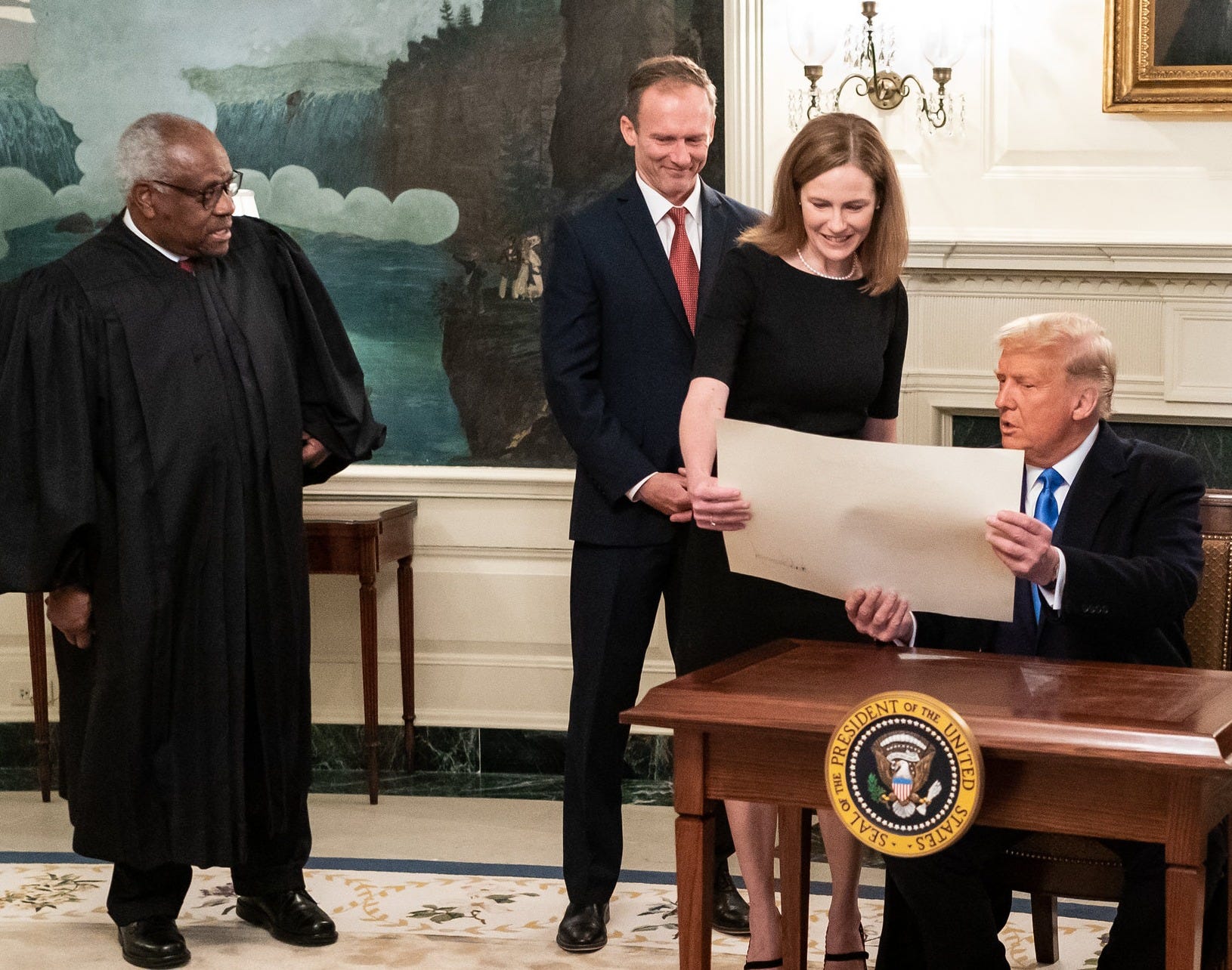
No more of that. Democratic voters have to force their candidates to embrace real, aggressive Supreme Court reform. That means not only coming up with a plan (including, most likely, term limits and court expansion) but being unrestrained in how they talk about these six villains who are destroying our democracy. They are every bit as much of a threat to what we hold dear as Donald Trump is, but if Democrats won’t say so, they can’t sow the ground for the reform that is so terribly necessary.
The redistricting case
Let’s spend a moment on the redistricting case, because while it may not be the most appalling thing this court has ever done, it’s illustrative of the way it operates and why it must be reined in — and it’s one more step toward the realization of the goal that has animated Chief Justice John Roberts’ entire career, the eventual destruction of the Voting Rights Act.
After its trial, the district court ruled that in pursuing its aim of maximizing the number of Republican House seats, the Texas legislature violated the Constitution and clear Supreme Court precedent. The legislature set out to break up “coalition districts” that include a majority made up of multiple racial groups into separate Black districts (which will vote Democratic) and Hispanic districts (which they believe will vote Republican, though this may or may not turn out to be true). This, the district court found, was an explicit racial gerrymander and therefore illegal.
But the six conservative justices decided to toss the district court’s extensive fact-finding in the trash, for one reason only: It didn’t produce the result they wanted. In three snide paragraphs, Justice Samuel Alito dismissed the 160-page district court ruling, for two absurd reasons. First, Alito wrote, “the District Court failed to honor the presumption of legislative good faith” on the part of Texas Republicans. That is simply bogus; rather than relying solely on anyone’s good faith, the district court examined the evidence at length, and judged accordingly. Second, said Alito, the district court supposedly erred by rejecting the new map, which no one has ever voted under, “on the eve of an election,” i.e. an election that is 11 months away.
This is called the “Purcell principle,” which begins from the quite reasonable idea that courts should refrain from changing the rules of elections, including district lines, right before an election takes place. But in practice, Purcell has become an infinitely flexible tool that the conservatives apply or ignore at their whim. If a change in the rules will benefit Democrats, Purcell is deployed to strike it down, no matter how far away the next election actually is. If the change will benefit Republicans, no matter how close the election is, Purcell is placed gently back into its scabbard, and the changes are allowed. But in this case, the Court deployed Purcell to force a change — a new map, rather than the one that has been in place since 2021 — while claiming it was doing exactly the opposite.
The Supreme Court is out of control, and Democrats have to say so
That’s how this Court operates; there are dozens of other cases to illustrate the point, up to and including the case in which it granted Donald Trump, far and away the most corrupt president to ever occupy the Oval Office, the right to do all the crimes he wants. But most critically for the future, the court has created a set of principles and tools meant for itself to use to achieve the policy goals it wants. Purcell is one; the end of “Chevron deference,” which previously said that federal agencies can decide how to apply statues, is another; the “major questions doctrine,” which they invented out of whole cloth, is a third. The mother of them all is “originalism,” which states that any law’s constitutionality is determined by whether a right-wing justice’s law clerk can find a quote from the Federalist Papers or a bill considered in the Virginia House of Burgesses in 1750 that seems to support whatever outcome the conservatives want.
The six conservatives have deployed these tools again and again to advance the interests of the Republican Party and their own policy preferences. Precedents have no bearing, the plain text of statutes has no meaning, and their own authority has no limit. They are out of control, and their reign of judicial terror must come to an end.
Any Democrat who says “Voters don’t really care about this stuff” needs a good smack in the head. The answer to that problem is to make them care. Republicans do this all the time; if they have something they wish was on the agenda, they force it on the agenda, no matter how ridiculous it is or how removed it is from people’s lives. How many Americans cared five years ago about whether some middle school trans kid a hundred miles from where they live wanted to play softball? But they care about it now, because Republicans made them care.
Democrats need to do the same with the Supreme Court — loudly, angrily, personally, relentlessly. If they don’t, the next Democratic president is utterly screwed. That president is going to have an extraordinarily challenging job before them, perhaps the most difficult since FDR took office in 1933. Trump will have left the federal government in ruins, and rebuilding it will take years — and a kind of urgent, vigorous exercise of authority that goes against Democrats’ inclinations toward caution and consensus. If and when that Democrat gets down to the business of rebuilding, the Court’s conservatives are going to do everything in their power to sabotage that effort. Without court reform, four years later that Democrat will be considered a failure, and another Republican will take office to continue Trump’s work of destruction.
Avoiding the practicality trap
If Democratic candidates do what I’m suggesting, they will immediately be met with a particular response, both from centrists within their party and from the elite news media. Shifting attention from the crisis the Court has created, they will descend upon the aggressive Democrats advocating court reforms with questions about practicality. Surely you’re being unrealistic, they’ll say, fingers wagging furiously at this naïve, pie-in-the-sky notion.
We saw this vividly in 2020 with the debate Democrats had about health care. The party’s constituents were eager for progress, not just to shore up the Affordable Care Act but to create genuinely universal (and affordable) coverage. Even the “moderates” in the race, including Joe Biden, presented plans far more progressive than the ACA itself. But those who advocated some form of single-payer, especially Bernie Sanders, were buried under an avalanche of “But how would you pay for it???” scolding, the kind of question never asked of anything Republicans propose except in the most perfunctory way.
This is how establishment media respond to any sign of vigor on the part of Democrats, by using their own instincts toward seriousness against them, and it’s what they’ll do when Democrats advocate court reform. Can you get the votes in Congress? Isn’t it going to be complicated? Won’t it cause confusion? The answer is not to just ignore any question of practicality, but to always shift the debate back to the villainy of this Supreme Court and the need to stop them. There are plenty of reform proposals out there, and they’re perfectly practical; Congress can change the size of the court (as it has done many times before), impose term limits, and much more. All that’s necessary is the will to do it.
That will can be created, if Democrats are willing to push hard enough. But they have to start now.
Thank you for reading The Cross Section. This site has no paywall, so I depend on the generosity of readers to sustain the work I present here. If you find what you read valuable and would like it to continue, consider becoming a paid subscriber.