
We've Been Thinking About Electability All Wrong
Just being a moderate doesn't make a candidate electable. Here's what does.

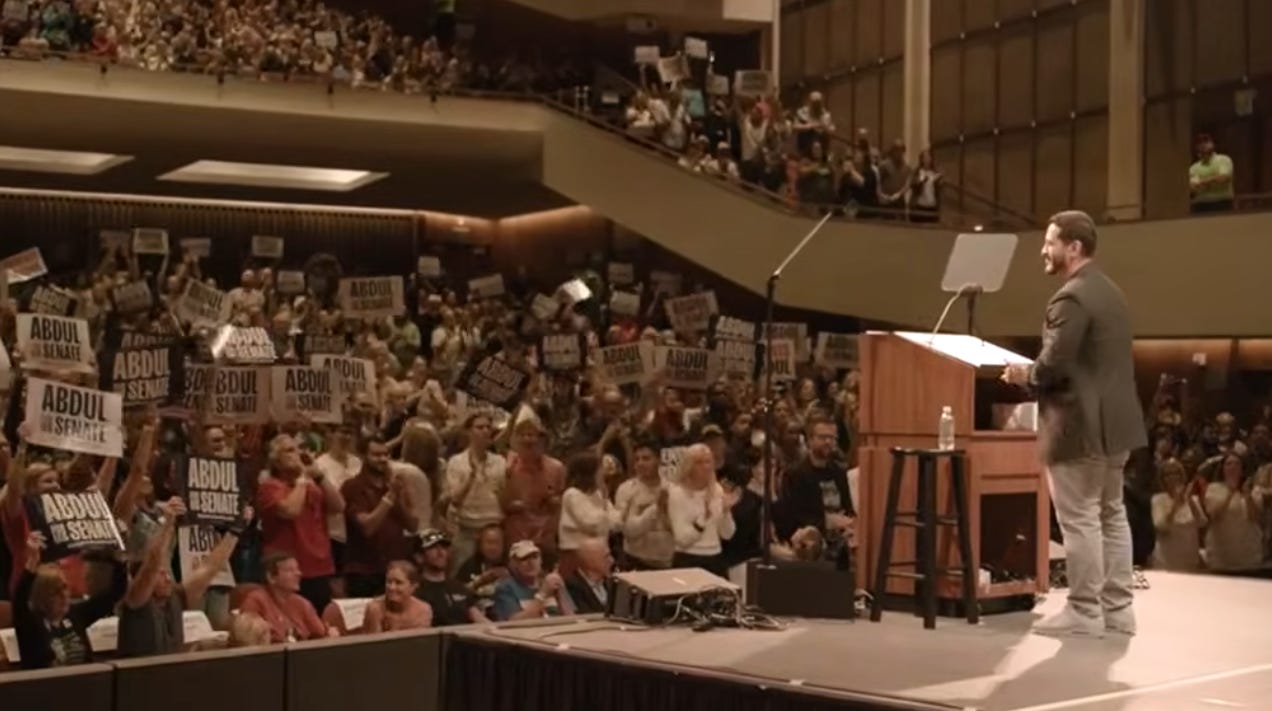
The Democratic primaries, especially those in Michigan (today) and Wisconsin (next Tuesday) have once again brought up the issue of “electability.” As usual, the more moderate candidates argue that primary voters should choose them because they’re electable, and the progressives argue that in fact they’re the electable ones. There’s no question that the Democratic Party, in the states but especially in Washington, agrees with the moderates.
One way to address this question, which I’ve advocated in the past, is to say that primary voters should stop worrying about electability altogether. Instead of trying to figure out which candidate someone else might like, vote for the candidate you like, and you’ll probably wind up doing better in the end.
Unfortunately, primary voters, who are more aware and involved than the average voter, love playing amateur political consultant; it’s difficult to get them to stop thinking about the general election. So rather than ignoring it, we should rethink what we talk about when we talk about electability.
The old way of thinking about electability
The traditional conception of electability is simple and straightforward:
“The more ideologically moderate candidate is the more electable one”
Sometimes you might throw in features of identity, like race and gender (i.e. white candidates are supposedly more electable than non-white candidates and men are more electable than women), but in this line of thinking, ideology is what matters most. If you need to win over a general electorate, especially in a closely divided state like Michigan or Wisconsin, you have to appeal to the middle, and you do that with moderate positions on policy issues.
As I’ve noted many times, in congressional races, policy moderation has lost much of the power it once had to give candidates an advantage. But even if it still helps rather than hurts in and of itself, it may be far less important than other factors — and it’s certainly not so powerful that we should assume that it swamps everything else.
Yet that’s how the Democratic Party often treats it. When the party apparatus like the Democratic Senatorial Campaign Committee and Democratic Congressional Campaign Committee are trying to figure out which candidate to throw their support behind and which to try to push out of a race, they look for candidates who can raise money (i.e. they’re either rich enough to self-finance or they have a lot of rich friends), candidates who are already known to voters, and perhaps above all, candidates who are safe centrists.
It’s not always a bad formula. For instance, former governor Roy Cooper was recruited by Chuck Schumer to run in North Carolina, and he checks all the boxes — and it looks like he’s probably going to win. But apply the same formula everywhere, and you get candidates like Haley Stevens, an uninspiring normie Democrat who was also the party’s choice, and looks like she’s going to get beaten by Abdul El-Sayed in the Michigan Senate primary.
A better way to think about electability
I can’t say for sure which of those two is more electable, because we can’t run the experiment twice. Polls taken now aren’t all that useful given that the general election hasn’t started, but they seem to show Stevens doing a tiny bit better than El-Sayed against Mike Rogers, who will be the Republican nominee — but within the margin of error, so no meaningful difference.
While it’s certainly possible for a candidate to be so at odds ideologically from the state they’re running in that they can’t win, that’s usually not what people highlight when they argue that electability ought to be the top concern. Instead, they often point to candidates who flamed out spectacularly and lost winnable races, like Christine O’Donnell in Delaware in 2010, or Todd Akin in Missouri in 2012.
But those examples almost never have anything to do with ideology. O’Donnell was so wacky that she felt compelled to air an ad making clear that she was not, in fact, a witch. Akin averred that rape exceptions in abortion bans were unnecessary because in a “legitimate rape,” a woman’s mysterious ladyparts will render a pregnancy impossible. They were just terrible candidates.
On the other side, Barack Obama wasn’t electable because Black men with thin resumes and the middle name “Hussein” are always great to nominate for president. And Donald Trump wasn’t electable because vulgar con men who sexually abuse women are the strongest candidates.
So if ideological moderation isn’t the most important factor in genuine electability, what is? I’d argue there are three key variables:
Electability factor #1: The timing. Timing is perhaps the most under-considered determinant of political outcomes, but it affects everything. Obama’s timing was perfect in 2008; the Iraq War, the financial meltdown, and the end of the unpopular Bush presidency primed the public for someone who represented the most dramatic break possible with the status quo, and he was it. Likewise, in 2016, with the gnawing feeling that the system wasn’t serving people well, plus the yearning among so many voters for an authentic racist and misogynist (especially given that Hillary Clinton was the Democratic nominee), Trump’s despicable personality and outsider status allowed him to squeak to victory when he might not have been able to in a different year.
Electability factor #2: The candidate. This seems obvious, but it apparently isn’t. Good candidates are more electable than bad candidates, whatever their ideology, and charisma matters. Watch Haley Stevens and Abdul El-Sayed for any length of time, and it becomes clear that he’s just a better politician on the campaign trail than she is. He’s more articulate, he speaks less in bromides and cliches, he’s confident where she’s cautious, he’s willing to try to persuade anyone while she doesn’t quite know how to deal with being challenged, and he seems to be outworking her. Good campaigners don’t always make good officeholders, but being good at campaigning makes a difference in getting elected.
Electability factor #3: The message. This is directly related to factor #1: Has the candidate hit upon a message that is not just compelling, but compelling at this particular moment? The political situation of this moment is that voters are pissed off — they’re pissed off at Trump, they’re pissed off about the economy, they’re pissed off about corruption, and they’re pissed off at the fact that ten years after Trump himself said he was going to fight a “rigged” system, the system seems more rigged than ever.
El-Sayed’s answer is a simple slogan that he repeats over and over and has even turned into a call-and-response at his rallies: “Money out of politics, money in your pocket, Medicare for all.” It may not be all-encompassing, but it’s easy to remember and it communicates what he’s about.
Stevens says some of the same things — her website says “Haley is running for Senate to continue to fight for Michiganders and our economy while standing up to the Trump-Musk chaos agenda” — but in part because she is in fact a creature of the establishment, the “fighter” stuff doesn’t come off as particularly authentic, and she can’t plausibly say she’s going to challenge the status quo.
In a different year, Stevens might be able to argue persuasively that she’s the more electable one. But to make that argument this year, you’d have to still believe that ideology is all that matters. Or that the inevitable torrent of hateful anti-Muslim bigotry Republicans will pour down on El-Sayed will be enough to defeat him (which maybe it will).
Anyhow, this is my plea: If we’re going to talk about electability, don’t limit it to ideology, because that’s only a small part of the story.
One final note, especially given that it looks like El-Sayed is going to win, as will Francesca Hong in the Wisconsin governor race, as have a number of other progressive candidates who have challenged Democratic incumbents. If you haven’t seen it yet, I wrote a piece at Public Notice about the decision moderate Democrats will face once the primaries are over: Should they keep attacking progressive candidates who won, in order to fight a supposed “battle for the soul of the party,” or should they do everything they can to help those candidates win even if they aren’t all that comfortable with them? You can probably imagine which position I take, but I think the full argument might be worth your time.
Thank you for reading The Cross Section. This site has no paywall, so I depend on the generosity of readers to sustain the work I present here. If you find what you read valuable and would like it to continue, consider becoming a paid subscriber.
If people wanted moderates, they wouldn't have elected the world's most impulsive extremist... twice. Once you could maybe rationalize away, but not now. Any Democrats preaching moderation immediately lose my vote because it proves how incredibly naive they are about the true state of the electorate. Joe Biden is proof that moderation didn't earn Democrats one shred of respect or loyalty in the 2024 election. I wouldn't vote for Biden if he was still a primary candidate today.
“Instead of trying to figure out which candidate someone else might like, vote for the candidate you like, and you’ll probably wind up doing better in the end.”
What a radical idea, Paul!
What say you, however, of Francesca Hong‘s quote “I support defunding the police as a first step towards abolishing the police?”