
Why the Democratic Centrists Are Losing
If this is a battle for the party's soul, the side that has no constituency isn't going to win.

Democratic centrists have a problem. They have enormous influence over the debate — indeed, they manage to get national news coverage almost at will as they complain that the Democratic Party has moved too far to the left and will doom itself if progressives are allowed to take over. Their problem is that they don’t represent any actual voters.
I don’t mean that there aren’t moderate Democratic voters; there are plenty of them. It’s a perfectly reasonable thing to be, and they have as much right as anybody to make the case for their beliefs. But the professional centrists aren’t connected to them in any meaningful, practical way.
Nor, for that matter, have the centrists managed to find charismatic, dynamic candidates to carry their banner, even if moderate Democrats have won some primaries. What they’re left with is something of a Potemkin movement, in which a small number of people rail against the prevailing trend in the Democratic Party and get lots of attention for their arguments, but are unable to make much progress in their real goal — fighting progressives — in part because they aren’t inclined to engage in politics on the ground.
If you’re in a battle for the soul of your party, that’s a recipe for defeat.
I’m not going to settle the case of Moderation v. Mobilization here, except to note that for most candidates, in an environment where all politics is national, moderating on issues has lost most of the efficacy it once had. Furthermore, the problem Democrats have is not that voters think they’re extreme on policy, but that voters think they’re weak.
That perception is common among Democrats themselves, which helps explain why progressive candidates are doing so well right now. Democrats who don’t seem to believe in anything all that strongly are being lapped by candidates whose progressive ideas and sense of outrage signal to voters that they are eager for change and want to fight.
Why the centrists can’t hold back the progressive tide
So you get races like the one for Wisconsin governor, where a new Marquette University poll shows state Rep. Francesca Hong with 38%, former lieutenant governor Mandela Barnes (who lost a Senate race four years ago to the odious Ron Johnson) with 16%, and Milwaukee County Executive David Crowley (who has the endorsement of Gov. Tony Evers) with 7%.
Cue the freakout:
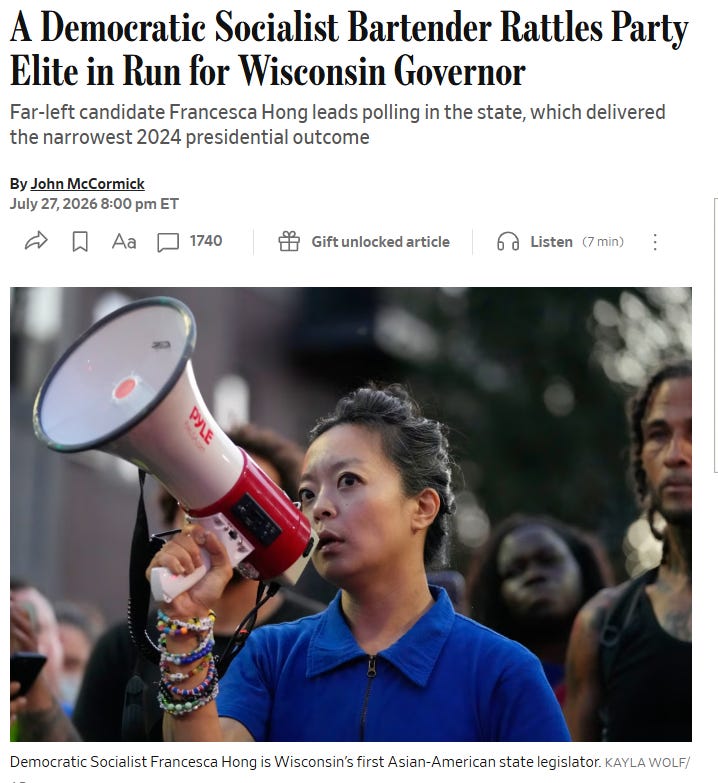
Every race is a little different, but we’re seeing something similar play out in many Democratic primaries: A lefty candidate goes up against a couple of uninspiring mainstream Democrats and captures the bulk of the attention and votes, leading centrists both inside and outside the state to shout “How could this have happened? We’re doomed!”
One of the arguments the centrists make is that it might be fine for a socialist to win in New York, but they can’t win in a closely divided state like Wisconsin or Michigan. But as Perry Bacon points out, strongly progressive candidates have won lots of races in swing states and swing districts in recent years. Wisconsin senator Tammy Baldwin is rated by Voteview (the most objective measure I know of) as more liberal than 90% of congressional Democrats — and she won a third term in 2024, when Trump won the state. That doesn’t mean Hong will win a general election if she gets the nomination, but it does mean that the fact that she’s farther to the left than her primary opponents isn’t in and of itself a bar to victory. And those backing Barnes and Crowley should ask themselves why the candidates they’re backing don’t seem to have much appeal to the voters.
Right now, the argument against the progressive candidates is being carried by has-been pundits and groups like Third Way, which are quite well-funded but have no identifiable constituency. They’re basically a bunch of people sitting around in a Washington office writing op-eds. That’s not a useless endeavor — spreading ideas is worthwhile, depending on the ideas — but when it gets down to the crunch time of an election, it isn’t particularly potent.
In stark contrast, the Democratic Socialists of America have become a formidable force within the Democratic Party because they are committed to organizing. They’re out there knocking doors and making calls and staging events every day, which is something that the centrists aren’t doing. When the political context shifted in a way that made their outsider persona and uncompromising policy ideas more appealing, they were ready to take advantage.
Now, it’s true that there are people and factions within the DSA that believe some pretty far-out things, things that lots of politicians who are either members or associate themselves with the group (including the most prominent ones like Zohran Mamdani) don’t agree with. But the point is, they’re doing politics, while the centrists’ strategy seems to be focused mostly on getting attention from the elite media.
And as much as the centrists beg candidates to focus on those magical “kitchen-table issues,” that’s exactly what the successful DSA candidates are doing. What do you think universal health care and child care are about, if not the everyday reality of people’s lives? And here’s something else that’s important: While centrists often complain that Democrats are trapped in their self-reinforcing bubbles and disconnected from reg’lar, salt-of-the-earth Americans, nearly all the centrists that I’m aware of are just as disconnected, if not more so.
Bubbles come in many forms
They live in Washington or other major cities, they’re immersed in politics, and they suffer from the Pundit Brain ailment that makes its victims believe ordinary voters have coherent ideological beliefs and respond to subtle changes in the policy-based appeals candidates make. There’s something else going on, too: Their view of the political world is dominated by their contempt for the far left, which convinces them that what we used to call hippie-punching is the cleverest of political strategies.
This is a phenomenon I’ve noticed in many normie Democrats I know who live in very liberal places. They can’t stand Trump, of course, but the people who really drive them up a wall are the ones they encounter all the time where they live: the lefties.
This is a variation on a more familiar phenomenon, that of the radical who hates the internal rivals on their own side much more than they hate the enemy they’re all supposed to be fighting. That’s the Judean People’s Front effect:
But the hatred of the center for the extreme may be just as common, and the reason is familiarity. If you’re a mainstream Democrat who lives in San Francisco or New York, you almost never encounter MAGA-hatted, immigrant-hating, misogynistic far-right troglodytes in person. You see them online, you know they’re there, but you don’t have to pay more than a moment’s attention to them if you don’t want to. On the other hand, far-lefties are everywhere in your actual life, and everything you find annoying about them is right in your face, all the time.
I know people who say that if they have to hear one more land acknowledgement, or watch a couple jump up at the beginning of a concert to try to start a “Free Palestine!” chant when there are only liberals in the audience anyway, they’re going to lose their minds. Lefties are big on public expressions of belief in ostensibly non-political contexts — sometimes confrontational ones — and it’s not surprising that many liberals find it exasperating and often counter-productive.
An unusually thoughtful and magnanimous normie liberal might conclude that while the people pestering them at the supermarket are sometimes carried away by the exuberance of youth or aren’t quite as informed as they might be, their hearts are basically in the right place and they agree with them on fundamental goals like justice and equality. But that’s not easy to do when the people you find so annoying are all around you.
We all have people on our side who drive us up the wall for one reason or another. But there are a couple of things to remember as the primary season continues to play out. First, the centrists should understand that the current momentum behind the far left was enabled by the failures of mainstream Democrats and centrists in particular. Where are the dynamic, charismatic, politically adept, and appealing centrist Democratic candidates? Well let’s see…there was Bill Clinton, who ran his last race 30 years ago.
Second, you should guard against the belief that if people in your party whose policy beliefs are different from yours win elections, the whole party is doomed. Just look at the experience of the Tea Party, a bunch of halfwits traipsing around in tricorn hats advocating unpopular ideas. They took over the GOP after Barack Obama was elected, and what followed was a series of Republican victories — in 2010, 2014, and 2016 — broken only by a presidential election in which the party nominated a more traditional candidate.
The Democrats might not have a similar run of success after the current progressive uprising. But if the centrists now warning of doom could point to their own political achievements, they’d have a much stronger case to make.
Thank you for reading The Cross Section. This site has no paywall, so I depend on the generosity of readers to sustain the work I present here. If you find what you read valuable and would like it to continue, consider becoming a paid subscriber.
A really thought-provoking piece by Paul Waldman.
So I’m 75. I voted for two very competent women.
I think the person who wins the primary deserves our support. I always thought I was a progressive?? But:
I don’t think a person who doesn’t belong to the Democratic Party&has acted as a spoiler deserves much adoration.
I think Netanyahu is a war criminal. Gaza is genocide, we give too much money to Israel, but Hezbollah&Hamas are terrorist too. I think Israel deserves to exist in peace.
What would America look like if Hillary Clinton or Kamala Harris had been elected.
A minority of voters protested 2 competent women gave us 2 Trump terms. But are the only worthy voices in the party?